
Key Takeaways
- Sahih al-Bukhari and Sahih Muslim are the two collections Sunni scholars call "the two Sahihs" (as-Sahihayn). Both aim to contain only authentic narrations; they differ mainly in how they are built.
- Al-Bukhari splits a hadith across many chapters, each with a heading that states the lesson. Muslim gathers all the chains of one hadith in one place, so you can compare wordings side by side.
- The hadith of intention shows it clearly: in this site's library it appears in 7 different books of al-Bukhari, but at one spot in Sahih Muslim (1907 a), followed by records that list further chains.
- References to Sahih Muslim mark grouped transmissions with letters (1907 a, 1907 b). In our library, 6,255 of Sahih Muslim's 7,470 records carry such a letter, against 10 of al-Bukhari's 7,291.
- Read Sahih al-Bukhari when you want the compiler's chapter lessons; read Sahih Muslim when you want every version of a narration together. For rulings drawn from either, ask a qualified scholar.
If you have started reading hadith, you have met both names on almost every reference: "Bukhari and Muslim". The two books are usually mentioned together, and that makes it easy to assume they are two copies of the same thing. They are not. They share many narrations, but they were organised for different purposes, and that changes how you read them, how you cite them and how their numbers behave.
I am a software engineer, not a scholar, so this comparison stays with what can be checked: who compiled each book, how each is arranged, and what the actual records in this site's library show. Where a point depends on scholarly judgement, I name the scholar. For the wider family of books, start with the six major hadith books explained.
How do the two Sahihs compare at a glance?
The two books share a goal and differ in method. This table puts the main differences side by side. The counts come from this site's library of Sahih al-Bukhari and Sahih Muslim; printed editions count differently.
| Feature | Sahih al-Bukhari | Sahih Muslim |
|---|---|---|
| Compiler | Muhammad ibn Isma'il al-Bukhari (810–870 CE) | Muslim ibn al-Hajjaj (c. 817–875 CE) |
| Compiler's home region | Bukhara, Central Asia | Nishapur, Khurasan |
| Books in this library | 97 | 56 books plus an Introduction (57 sections) |
| Records in this library | 7,291 | 7,470 |
| Opening material | Opens directly with a book on Revelation | Opens with an Introduction (Muqaddimah) on narrators and method |
| How one hadith is placed | Split and repeated under many chapter headings | Gathered in one place with all its chains |
| Chapter headings | Written by al-Bukhari, and they carry his reasoning | Headings in common editions were added by later scholars |
| Typical reference | Sahih al-Bukhari 1 | Sahih Muslim 1907 a |
| Best for | Seeing the compiler's lesson for each chapter | Comparing the wordings of one narration |
Who compiled each book, and when?
Both compilers lived in the third century of Islam, in the eastern lands of the Abbasid world, and they knew each other. Britannica gives al-Bukhari's dates as 810 to 870 CE, born in Bukhara and buried at Khartank near Samarkand. It gives Muslim ibn al-Hajjaj's birth as about 817 in Nishapur and his death in 875 (Britannica, al-Bukhārī; Britannica, Muslim ibn al-Ḥajjāj).
Muslim was the younger of the two. The classical scholar Ibn al-Salah notes that al-Bukhari was the first to compile a book limited to authentic hadith, and that Muslim, who studied with him, followed him (Ibn al-Salah, An Introduction to the Science of the Hadith). That order matters for one reason: Muslim knew his teacher's method and chose a different arrangement on purpose.
How are the two books arranged?
The biggest practical difference is arrangement. Both books are organised by subject, but they solve a different problem.
Al-Bukhari: chapters that teach a point
Al-Bukhari wrote a heading for each chapter, and the heading often states a conclusion. He then placed under it the narration, or the part of a narration, that supports that conclusion. When one hadith supports several points, he repeats it, sometimes in full and sometimes cut down to the relevant part. Scholars have a well-known saying that al-Bukhari's understanding (fiqh) is in his chapter headings, which is why commentators spend so much time on them (Brown, Hadith).
For a reader, this means the same narration turns up in places you might not expect. It also means a short version under one chapter can be completed by a longer version elsewhere in the book. Our reader's guide to Sahih al-Bukhari walks through its 97 books.
Muslim: every chain of a hadith in one place
Imam Muslim took the opposite route. As a rule, he placed a narration once, at the point in the book where it fits best, and then listed its other chains of transmission straight after it. Often he notes how the wording differs from one chain to the next. The result reads less like a set of lessons and more like a well-ordered file of evidence.
The chapter headings you see in printed editions and on websites were not written by Muslim. They were added by later scholars; the headings in common use are usually attributed to an-Nawawi's commentary (Brown, The Canonization of al-Bukhārī and Muslim). If you quote a chapter title from Sahih Muslim, it is the commentator's wording, not the compiler's.
One hadith, two placements: the hadith of intention
The clearest way to see the difference is to follow a single narration through both books. The hadith of intention, narrated by 'Umar ibn al-Khattab, is a good test because both compilers included it. (Read the same narration in Nawawi's collection with its source note.)
Al-Bukhari opens his whole book with it. This is the record in our library:
Narrated 'Umar bin Al-Khattab: I heard Allah's Messenger (ﷺ) saying, "The reward of deeds depends upon the intentions and every person will get the reward according to what he has intended. So whoever emigrated for worldly benefits or for a woman to marry, his emigration was for what he emigrated for."
— Sahih al-Bukhari 1, In-book: Book 1, Hadith 1 (library page; sunnah.com)
Arabic text of Sahih al-Bukhari 1:
إِنَّمَا الأَعْمَالُ بِالنِّيَّاتِ، وَإِنَّمَا لِكُلِّ امْرِئٍ مَا نَوَى، فَمَنْ كَانَتْ هِجْرَتُهُ إِلَى دُنْيَا يُصِيبُهَا أَوْ إِلَى امْرَأَةٍ يَنْكِحُهَا فَهِجْرَتُهُ إِلَى مَا هَاجَرَ إِلَيْهِ
Muslim places it far into his book, in the Book on Government (Kitab al-Imarah), next to narrations on intention in fighting and martyrdom:
It has been narrated on the authority of Umar b. al-Khattab that the Messenger of Allah (ﷺ) said: (The value of) an action depends on the intention behind it. A man will be rewarded only for what he intended. The emigration of one who emigrates for the sake of Allah and His Messenger (ﷺ) is for the sake of Allah and His Messenger (ﷺ) ; and the emigration of one who emigrates for gaining a worldly advantage or for marrying a woman is for what he has emigrated.
— Sahih Muslim 1907 a, In-book: Book 33, Hadith 222 (library page; sunnah.com)
Arabic text of Sahih Muslim 1907 a:
إِنَّمَا الأَعْمَالُ بِالنِّيَّةِ وَإِنَّمَا لاِمْرِئٍ مَا نَوَى فَمَنْ كَانَتْ هِجْرَتُهُ إِلَى اللَّهِ وَرَسُولِهِ فَهِجْرَتُهُ إِلَى اللَّهِ وَرَسُولِهِ وَمَنْ كَانَتْ هِجْرَتُهُ لِدُنْيَا يُصِيبُهَا أَوِ امْرَأَةٍ يَتَزَوَّجُهَا فَهِجْرَتُهُ إِلَى مَا هَاجَرَ إِلَيْهِ
The very next record, Sahih Muslim 1907 b, is not a new hadith. It reads: "It has been narrated through a different chain of transmitters on the authority of Sufyan who said that he heard 'Umar b. al-Khattab relate (this tradition) from the Prophet (ﷺ) while he was delivering a sermon from the pulpit." That is Muslim's method in one line: same text, another chain, recorded right beside the first.
Compare the two quoted texts as well. Al-Bukhari's first record mentions only emigration for worldly gain or marriage, while Muslim's record also includes the clause about emigration "for the sake of Allah and His Messenger". Al-Bukhari gives that fuller wording elsewhere, for example at Sahih al-Bukhari 54. This is the kind of difference you only see by reading both books.
Where the hadith of intention appears in al-Bukhari
I searched the Arabic text of our library for the phrase "mā nawā" ("what he intended") and the matching wording. In Sahih al-Bukhari, the hadith of intention appears in seven books. In Sahih Muslim, it appears at one location.
| Reference (links to library page) | Book in Sahih al-Bukhari |
|---|---|
| Sahih al-Bukhari 1 | Book 1, Revelation |
| Sahih al-Bukhari 54 | Book 2, Belief |
| Sahih al-Bukhari 2529 | Book 49, Manumission of Slaves |
| Sahih al-Bukhari 3898 | Book 63, Merits of the Helpers in Madinah |
| Sahih al-Bukhari 5070 | Book 67, Wedlock, Marriage |
| Sahih al-Bukhari 6689 | Book 83, Oaths and Vows |
| Sahih al-Bukhari 6953 | Book 90, Tricks |
Look at the book titles: freeing slaves, marriage, oaths, legal tricks. Al-Bukhari placed the same words wherever he saw intention shaping the ruling, and he left the reader to connect the chapter to the hadith. Explaining each placement is the work of the commentators, such as Ibn Hajar in Fath al-Bari; the point for a reader is that the placement itself carries meaning. The search method was simple text matching, so it shows where this wording sits in our records, not a full scholarly count of every partial citation.
What standards did each compiler use?
For the main, fully chained narrations, both compilers required a continuous chain of trustworthy, precise narrators and no hidden defect (Brown, Hadith). Al-Bukhari's chapter headings also quote some reports without a full chain (mu'allaq); those sit outside his main conditions. The difference most often discussed is narrow and technical: how sure you must be that two narrators actually met.
Jonathan Brown summarises the usual account: al-Bukhari is reported to have required evidence that each narrator met the person he narrated from at least once, while Muslim, in the Introduction to his Sahih, argued that being contemporaries with a real possibility of meeting was enough, as long as the narrator was not known for concealing gaps (Brown, Hadith). For a beginner, the result is simple: al-Bukhari's condition is the stricter of the two on this one point.
This is why most Sunni scholars rank al-Bukhari's collection first. Ibn al-Salah states that view. He also records that Abu 'Ali an-Naysaburi and some scholars of North Africa preferred Muslim's book, and he explains that preference as meaning that, after its Introduction, Muslim's book contains nothing but authentic narrations, not that it is more authentic (Ibn al-Salah, An Introduction to the Science of the Hadith). Both books sit above the other collections, and the ranking is about the books as a whole, not a judgement on each single narration. Keep the supplied grade and its attribution when citing a particular record.
Why do the reference numbers look so different?
The numbering reflects the arrangement. Because Muslim groups the chains of one hadith together, the modern numbering by Muhammad Fu'ad 'Abd al-Baqi gives one number to the whole group. Online references in the sunnah.com style, which our library follows, then add a letter for each transmission; the letters are a reference convention, not part of the compiler's text or of printed editions. In our library, the Sahih Muslim references run up to 3033, yet there are 7,470 records, and 6,255 of them carry a letter such as "1907 a" or "12 b". Sahih al-Bukhari has 10 lettered references out of 7,291 records, because al-Bukhari's repeats are numbered as separate hadith.
Two practical rules follow from this:
- Copy the letter. "Sahih Muslim 1907" points to a group; "Sahih Muslim 1907 a" points to one record.
- Keep the reference, not the position. Our library page for Sahih Muslim 1907 a has the address
/sahih-muslim/4890, because 4890 is its position in our data, not its reference number. The number 1907 is the part most editions and sites share; a position in one database means nothing in another.
As an engineer, I find this the most useful single fact about the two books: they are not numbered in the same way, so a count of "hadith" in one is not comparable with the other. The library's source and numbering notes explain the record-ID distinction.
Which should you read first?
There is no wrong order, and both books reward a slow read. A practical rule:
- Start with Sahih al-Bukhari if you want to learn how a narration was applied. Read the chapter heading first, then the hadith, and ask what links them.
- Start with Sahih Muslim if you want to compare versions. Read the first record of a group, then the lettered records after it, and note what changes.
- Use both together when one of them gives a short version. A narration cut down in one book may be fuller in the other, so checking both can fill gaps.
Whichever you pick, keep the full reference with every note, use the library search to find parallel wordings, and take questions of meaning or practice to a qualified scholar. For a shorter starting collection, read why Nawawi's Forty Hadith matters.
Frequently Asked Questions
Is Sahih Muslim less authentic than Sahih al-Bukhari?
Most Sunni scholars rank al-Bukhari's collection first as a whole, and both books are treated as the most authentic hadith collections. The ranking compares the books overall. It does not mean a narration in Sahih Muslim is weak.
Do the two Sahihs contain the same hadith?
Many narrations appear in both, often through different chains. A narration found in both is usually described as "agreed upon" (muttafaq 'alayh). Each book also has material the other does not include.
Why does Sahih Muslim use letters in its numbers?
The letters mark separate transmissions grouped under one number. Sahih Muslim 1907 a and 1907 b are the same narration through different chains, recorded side by side.
Who wrote the chapter titles in Sahih Muslim?
Imam Muslim did not write the chapter titles found in common editions. Later scholars added them; the headings in common use are usually attributed to an-Nawawi.
Sources
- Britannica, "al-Bukhārī", Encyclopaedia Britannica: britannica.com/biography/al-Bukhari
- Britannica, "Muslim ibn al-Ḥajjāj", Encyclopaedia Britannica: britannica.com/biography/Muslim-ibn-al-Hajjaj
- Ibn al-Salah, An Introduction to the Science of the Hadith (Kitab Ma'rifat anwa' 'ilm al-hadith), trans. Eerik Dickinson, Garnet Publishing, 2006.
- Jonathan A. C. Brown, The Canonization of al-Bukhārī and Muslim: The Formation and Function of the Sunnī Ḥadīth Canon, Brill, 2007.
- Jonathan A. C. Brown, Hadith: Muhammad's Legacy in the Medieval and Modern World, Oneworld, 2009.
- Ibn Hajar al-'Asqalani, Fath al-Bari bi-Sharh Sahih al-Bukhari (commentary on Sahih al-Bukhari), cited as an example of the commentary tradition.
- Hadith Collection library: Sahih al-Bukhari, Sahih Muslim and about the library. Counts in this post come from the library's records.
- Sunnah.com: Sahih al-Bukhari 1 and Sahih Muslim 1907 a.
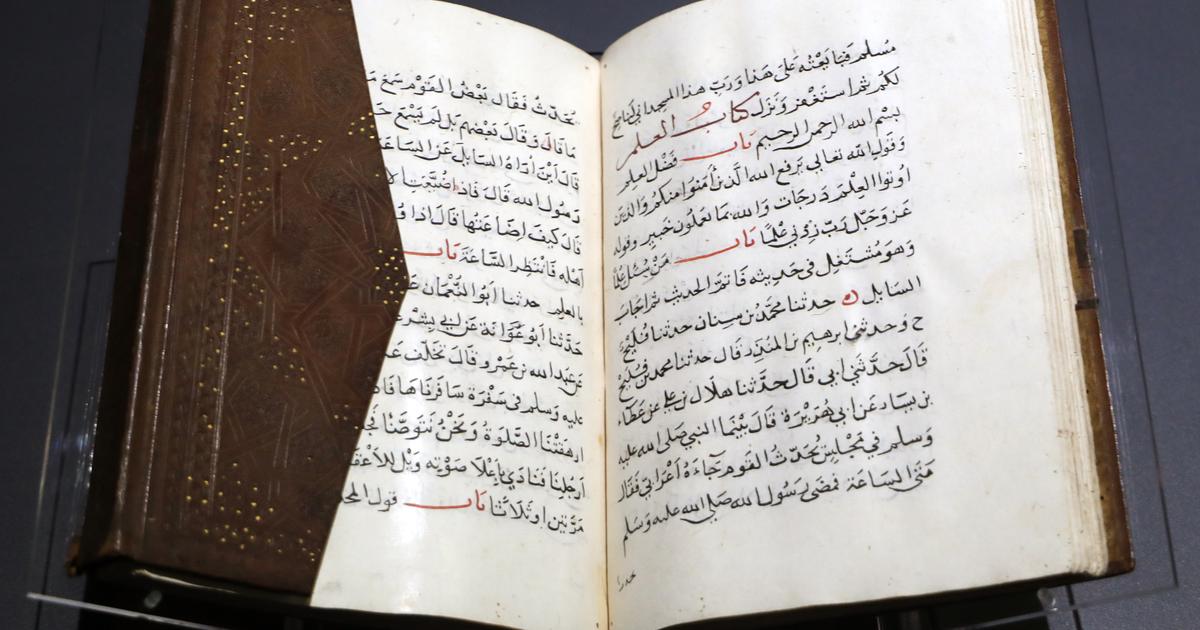
- Hero image: "Muhammed bin abdullah bin molla ismail, fethu'l-bari (raccolta di hadith bukhari), 1787" by Francesco Bini, Wikimedia Commons, licensed CC BY-SA 4.0. The manuscript is a copy of Ibn Hajar's Fath al-Bari, a commentary on Sahih al-Bukhari.