
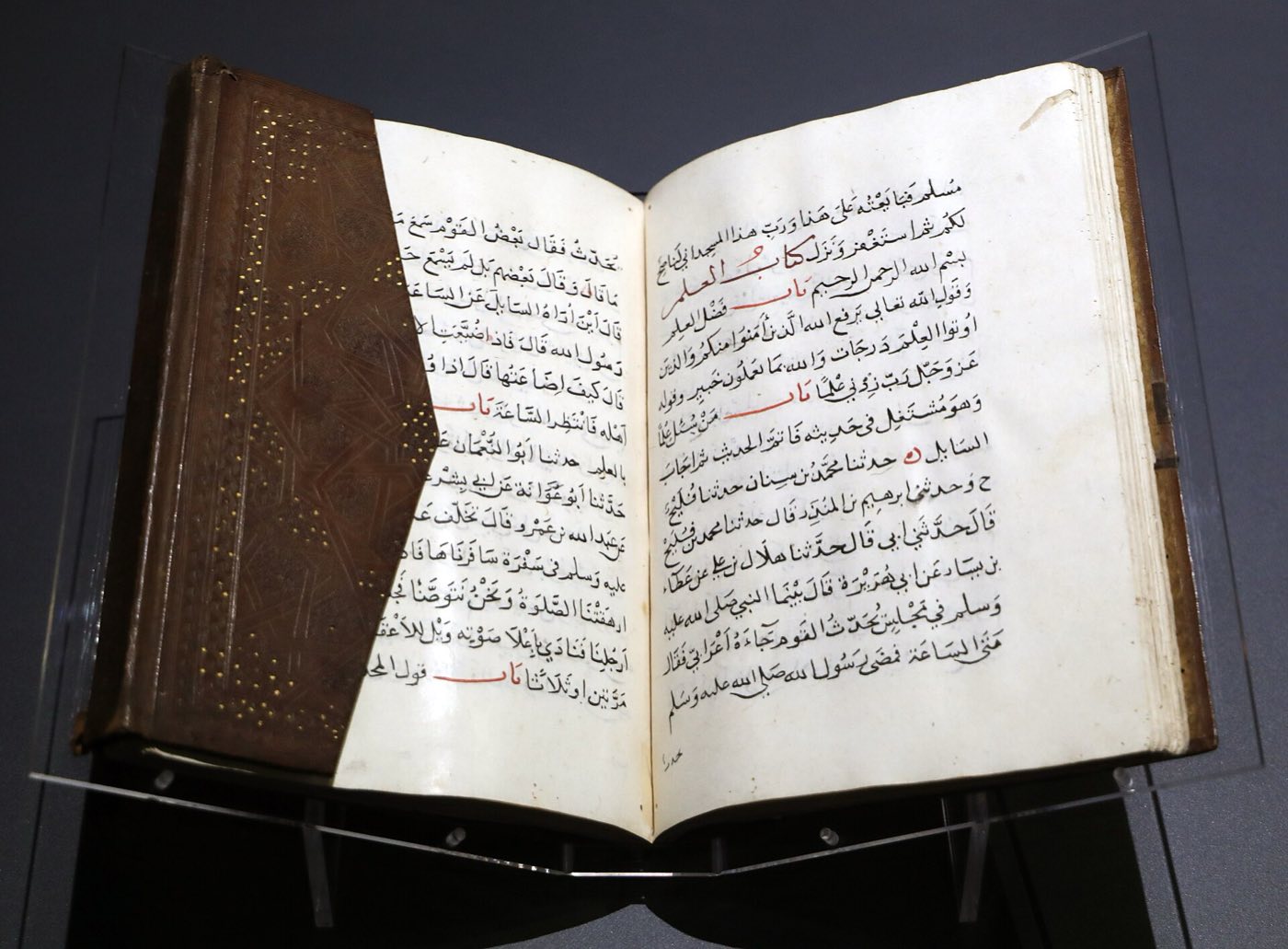
Sahih al-Bukhari is the hadith collection compiled by Imam Muhammad ibn Isma'il al-Bukhari (810-870 CE). Its 97 books move from revelation and belief, through worship and daily dealings, to the oneness of Allah. Sunni Muslims generally regard it as the most authoritative book after the Quran. This guide explains what the collection is, how its books are laid out, and how to read it without losing track of where each narration comes from. The image at the top shows an 18th-century manuscript of Fath al-Bari, a work on Sahih al-Bukhari, photographed at the Turkish and Islamic Arts Museum.
Key takeaways
- Sahih al-Bukhari was compiled by Imam al-Bukhari, who was born in Bukhara in 810 and died near Samarkand in 870 (Encyclopedia of World Biography).
- The work is divided into 97 books and about 3,450 chapters. It opens with the Book of Revelation and closes with the Book of Tawheed.
- Published totals for the number of hadith differ (7,275, 7,397, 7,563) because sources count repeated narrations and numbering schemes differently.
- Read it book by book, starting with Books 1-3, and always keep the full printed reference with any narration you save or share.
What is Sahih al-Bukhari?
Sahih al-Bukhari is a collection of narrations about the sayings and actions of the Prophet ﷺ, each given with its chain of narrators, that its compiler selected under strict conditions of reliability. The word sahih means "sound". The Encyclopedia of World Biography states that the work "is generally accepted by Sunnite Moslems as the most authoritative book after the Koran" (Encyclopedia.com).
Its compiler, Muhammad ibn Isma'il al-Bukhari, was born in Bukhara in 810 and died on 1 August 870 at Khartank, near Samarkand, according to the same entry. Britannica says he spent 16 years seeking out informants from Cairo to Merv. From roughly 600,000 traditions he gathered, he kept only about 7,275 that he judged completely reliable (Britannica).
It is one of the six major hadith books, alongside Sahih Muslim and the four Sunan. For how the two Sahihs compare, see Sahih Muslim vs Sahih al-Bukhari. For the wider picture, browse all 14 collections in the library, which include all six major books in Arabic and English.
Why do the hadith counts disagree?
The numbers you see quoted for Sahih al-Bukhari are not contradictory; they count different things. Britannica gives about 7,275. The Encyclopedia of World Biography gives 7,397 narrations with complete chains, "of which 4,635 are repetitions". The common numbering used by sunnah.com runs up to 7,563, which you can see in the reference printed on the last narration in this library: "Sahih al-Bukhari 7563".
As a software engineer, I read this as a counting-rule problem, not a data problem. Al-Bukhari often repeats a narration in several books, sometimes with a different chain or a shorter wording, because it supports a different chapter heading. Count every occurrence and you get one total; count only distinct narrations and you get a much smaller one. Editions and digital datasets also split or merge some records. The site's library holds 7,291 records across the 97 books, which is a property of this dataset rather than a new claim about the book.
How are the 97 books of Sahih al-Bukhari arranged?
The 97 books follow a clear order. The first three books set the foundations: Revelation, Belief and Knowledge. Worship comes next, then transactions and law, then history and virtues, then family and daily life, and finally the books on the heart, the end of time and creed. The groupings in the table below are my own reading aid, not divisions made by al-Bukhari; the book numbers and titles come from the site's book index.
| Books | Theme | Examples | Records in this library |
|---|---|---|---|
| 1-3 | Foundations | Revelation, Belief, Knowledge | 134 |
| 4-22 | Purification and prayer | Ablutions, Prayers, Call to Prayers, Friday Prayer, Witr | 1,068 |
| 23-33 | Funerals, charity, pilgrimage, fasting | Funerals, Zakat, Hajj, Fasting, I'tikaf | 776 |
| 34-58 | Trade, contracts and public law | Sales and Trade, Loans, Gifts, Witnesses, Wills, Jihad | 1,086 |
| 59-66 | Creation, prophets, history and the Quran | Beginning of Creation, Prophets, Companions, Al-Maghazi, Tafsir | 1,804 |
| 67-79 | Family and daily life | Marriage, Divorce, Food, Medicine, Dress, Good Manners | 1,211 |
| 80-97 | The heart, judgment and creed | Invocations, Ar-Riqaq, Divine Will, Afflictions, Judgments, Tawheed | 1,212 |
The size of a book tells you where al-Bukhari gathered the most material. In this library, the two largest books are Book 65, the Prophetic commentary on the Quran (Tafsir), with 498 records, and Book 64, the military expeditions (Al-Maghazi), with 488. Some books are tiny: Book 36 (Shuf'a) and Book 38 (Al-Hawala) have three records each.
What do the chapter headings add?
Each book is split into chapters, and the Encyclopedia of World Biography counts about 3,450 of them across the 97 books. Every chapter opens with a heading, traditionally attributed to al-Bukhari. A heading tells you which point the narrations beneath it are meant to support, which is why the same narration can reappear under several headings. When a narration surprises you by where it sits, read the chapter heading again before drawing any conclusion.
How to read Sahih al-Bukhari: a step-by-step plan
You do not need to read Sahih al-Bukhari from cover to cover to benefit from it, but a plan keeps you from reading isolated fragments. The steps below are the approach I would take as someone who treats references carefully. They are reading habits, not a method of scholarship; for interpretation and rulings, study with a qualified teacher.
Step 1: Begin with the first three books
Book 1, the Book of Revelation, opens with the narration on intentions. It reads in full:
Narrated 'Umar bin Al-Khattab: I heard Allah's Messenger (ﷺ) saying, "The reward of deeds depends upon the intentions and every person will get the reward according to what he has intended. So whoever emigrated for worldly benefits or for a woman to marry, his emigration was for what he emigrated for."
Sahih al-Bukhari 1, In-book: Book 1, Hadith 1 (Sahih al-Bukhari 1 in the library, sunnah.com)
Books 2 (Belief) and 3 (Knowledge) follow. Together the three books hold 134 records in this library, a realistic first goal for a few weeks of steady reading. The same narration also opens the Forty Hadith of Imam an-Nawawi, where it is hadith 1. Compare the full source notes in both records.
Step 2: Pick one book that matches a question you have
After the foundations, choose a book by topic rather than by number. If you want to understand prayer, start with Book 8; if you want manners, Book 78 (Good Manners and Form) is a good next step. Reading one book in full keeps each narration next to the ones al-Bukhari placed around it.
Step 3: Keep the full reference, not just the number
Every narration in this library carries a reference block such as "Sahih al-Bukhari 1 | In-book: Book 1, Hadith 1 | USC-MSA web (English): Vol. 1, Book 1, Hadith 1 (deprecated)". Those are three different numbering systems for the same narration. When you save or share a hadith, copy the whole line. A bare "Bukhari 3" is ambiguous between systems. The library's numbering notes explain how record IDs and edition references differ.
The library's own page number is a fourth identifier. For example, library record 7104 prints the reference "Sahih al-Bukhari 7371 | In-book: Book 97, Hadith 1". The address of a page is not the citation; the printed reference is.
Step 4: Notice repetitions and compare them
When you meet a narration you have already read, do not skip it. Compare the narrator, the wording and the chapter heading. The differences often show why al-Bukhari repeated it. Searching for a distinctive phrase in the hadith search is a quick way to find other occurrences.
Step 5: Read the closing narration
The collection ends in Book 97, the Book of Tawheed. This is the last narration in the collection:
Narrated Abu Huraira: The Prophet (ﷺ) said, "(There are) two words which are dear to the Beneficent (Allah) and very light (easy) for the tongue (to say), but very heavy in weight in the balance. They are: ''Subhan Allah wa-bi hamdihi'' and ''Subhan Allah Al-`Azim."
(see Hadith 6682).
Sahih al-Bukhari 7563, In-book: Book 97, Hadith 188 (Sahih al-Bukhari 7563 in the library, sunnah.com)
Common mistakes when reading Sahih al-Bukhari
Most reading mistakes come from treating one narration as the whole picture. Three are worth naming.
- Reading a narration without its chapter. The heading and the narrations around it shape what a passage is evidence for.
- Mixing numbering systems. "Vol. 9, Book 93" in an older English edition and "Book 97" in the in-book numbering can point to the same text. Always say which system you are using.
- Drawing rulings yourself. A sahih narration is reliable as a report; how it applies is the work of scholars who read it alongside the Quran and the rest of the Sunnah.
Frequently asked questions
How many books are in Sahih al-Bukhari?
Sahih al-Bukhari has 97 books, subdivided into about 3,450 chapters, according to the Encyclopedia of World Biography. The site's library follows the same 97-book division, from Book 1 (Revelation) to Book 97 (Tawheed).
Is everything in Sahih al-Bukhari authentic?
Al-Bukhari included only narrations he judged completely reliable (Britannica), and the Encyclopedia of World Biography notes that Sunni Muslims generally accept the book as the most authoritative after the Quran. Questions about specific narrations are for qualified scholars; this site reports grades only as its sources state them and does not assign grades.
Is Al-Adab al-Mufrad part of Sahih al-Bukhari?
No. Al-Adab al-Mufrad is a separate book by the same compiler, with its own narrations and gradings. You can read it as its own collection as Al-Adab al-Mufrad in the library.
Where to go next
Sahih al-Bukhari rewards slow, referenced reading: start with the first three books, then follow one topic at a time and keep every reference whole. You can browse all 97 books of Sahih al-Bukhari in the library, in Arabic and English, and read more about how the texts were sourced on the about the library page.
Sources
- "Muhammad ibn Ismail al-Bukhari", Encyclopedia of World Biography, Gale, via Encyclopedia.com
- "al-Bukhari", Encyclopaedia Britannica
- Sahih al-Bukhari 1 and 7563 on sunnah.com: bukhari:1 and bukhari:7563
- Text, references and book index: Sahih al-Bukhari in the Hadith Collection library
- Hero image: "Muhammed bin abdullah bin molla ismail, fethu'l-bari (raccolta di hadith bukhari), 1787" by Francesco Bini, Wikimedia Commons, licensed CC BY-SA 4.0
