
Key Takeaways
- Al-Adab al-Mufrad is a collection of narrations on manners and relationships compiled by Imam al-Bukhari (810-870). It is a separate book from Sahih al-Bukhari.
- It contains sayings of the Prophet ﷺ and also statements of Companions, so check who is speaking in each report.
- Its narrations are not uniformly graded. In the site's library, 720 of 1,136 records carry the grade "Sahih (Al-Albani)" and 126 carry "Da'if (Al-Albani)".
- Its printed numbering runs to 1,322, while the library's record identifiers stop at 1,136, so always cite the printed reference.
Al-Adab al-Mufrad is Imam al-Bukhari's book of manners: a collection of narrations about how to treat parents, relatives, children, neighbours, guests and people in general. This guide answers the questions readers most often have about it: what it is, how it relates to Sahih al-Bukhari, what it covers, how reliable its narrations are and how to read its references. It sits within the wider family of hadith books described in the six major hadith books explained.
I write as a software engineer, so where it helps I describe the book the way I would describe a dataset: how many records there are, what fields they carry and where the identifiers disagree. Those counts come from the library's own Al-Adab al-Mufrad data, and I say so each time.
Getting Started With Al-Adab al-Mufrad
What is Al-Adab al-Mufrad?
Al-Adab al-Mufrad is a hadith collection on adab, meaning manners, etiquette and good conduct. Its subject is that one theme, rather than the full range of topics found in a general collection. You can read it in the library's Al-Adab al-Mufrad collection or on sunnah.com.
The book opens with duty to parents. Its first record, as stored in the library, reads:
Abu 'Amr ash-Shaybani said, "The owner of this house (and he pointed at the house of 'Abdullah ibn Mas'ud) said, "I asked the Prophet (ﷺ) which action Allah loves best. He replied, 'Prayer at its proper time.' 'Then what?' I asked. He said, 'Then kindness to parents." I asked, 'Then what?' He replied, 'Then jihad in the Way of Allah.'" He added, "He told me about these things. If I had asked him to tell me more, he would have told me more."
Al-Adab Al-Mufrad 1, graded Sahih (Al-Albani). Library record 1 · sunnah.com
Who compiled it?
Muhammad ibn Isma'il al-Bukhari compiled it. Britannica's biography of al-Bukhari gives his birth as 810 in Bukhara and his death as 870 at Khartank, near Samarkand, and describes him as one of the greatest compilers of hadith. He is best known for Sahih al-Bukhari, which is covered in the reader's guide to Sahih al-Bukhari.
Who is the book for?
It suits readers who want narrations about daily conduct rather than legal detail. Its reports are mostly short and practical, and it is often read in study circles and at home. If you want a routine for that, the companion post reading Al-Adab al-Mufrad together as a family gives a step-by-step plan.
How the Book Works
Is Al-Adab al-Mufrad part of Sahih al-Bukhari?
No. It is a different book by the same compiler. The library's collection page puts it directly: this is a distinct work from Sahih al-Bukhari, and a shared compiler does not give every report the same grading. Sahih al-Bukhari also has its own chapter on manners (Kitab al-Adab), which is a separate thing again. When you cite a narration, name the book it came from.
| Feature | Sahih al-Bukhari | Al-Adab al-Mufrad |
|---|---|---|
| Compiler | Muhammad ibn Isma'il al-Bukhari | Muhammad ibn Isma'il al-Bukhari |
| Scope | Many subjects, from faith to rulings to history | Manners, relationships and conduct |
| Standing and grades | Among the most authoritative Sunni hadith collections (Britannica) | Grades vary: the library's records include sahih, hasan, da'if and ungraded narrations |
What topics does it cover?
The book is arranged by theme. In the library's data, the in-book references run from Book 1 to Book 57. Book 1 deals with parents, Book 2 with ties of kinship, Book 5 with children and Book 6 with neighbours, as the narrations in those books show. Later books move on to greetings, sneezing and yawning, and many other areas of conduct.
The book on neighbours opens with this record:
A'isha reported that the Prophet (ﷺ) said, "Jibril, may Allah bless him and grant him peace, kept on recommending that I treat neighbours well until I thought that he would order me to treat them as my heirs."
Al-Adab Al-Mufrad 101, graded Sahih (Al-Albani). Library record 101 · sunnah.com
For a reading routine using these themes, see reading Al-Adab al-Mufrad together as a family.
Does every report come from the Prophet ﷺ?
No. Many records quote the Prophet ﷺ, but the book also records statements of Companions. The second record in the library is an example, a saying of Abdullah ibn 'Umar:
Abdullah ibn 'Umar said, "The pleasure of the Lord lies in the pleasure of the parent. The anger of the Lord lies in the anger of the parent."
Al-Adab Al-Mufrad 2. Library record 2
Do not present a statement like this as words of the Prophet ﷺ. Keep the named speaker's attribution when copying the passage.
Why does the same narration appear more than once?
Because the book often records the same instruction, in nearly identical wording, through different chains. Records 56 and 57 in the library both carry the instruction to maintain ties of kinship, one through Anas ibn Malik and one through Abu Hurayra. Record 56 reads:
Anas ibn Malik reported that the Messenger of Allah (ﷺ) said, "Anyone who wants to have his provision expanded and his term of life prolonged should maintain ties of kinship."
Al-Adab Al-Mufrad 56, graded Sahih (Al-Albani). Library record 56 · sunnah.com
A repeated text through a second chain is part of how hadith books document transmission.
Grades and Reliability
Are all the narrations in Al-Adab al-Mufrad authentic?
No, and the library's records make this visible. Most records carry a grade labelled with al-Albani's name; 120 carry no grade at all, and a few have other or truncated labels. Counting the library's 1,136 Al-Adab al-Mufrad records:
| Grade field as stored | Records |
|---|---|
| Sahih (Al-Albani) | 720 |
| Da'if (Al-Albani) | 126 |
| No grade in the record | 120 |
| Hasan (Al-Albani) | 116 |
| Hasan Sahih (Al-Albani) | 17 |
| Other labels (for example "li ghairih" or "mauquf" variants, and some truncated strings) | 37 |
These are counts of the app's records, not a scholarly survey of every edition. They are enough to show that a reader must check the grade of each narration before relying on it. Record 51, for instance, is graded "Da'if (Al-Albani)". Keep the grading attribution with each record and take questions about its application to a qualified teacher.
Who is "Al-Albani" in the grade field?
It refers to Muhammad Nasir al-Din al-Albani, a hadith scholar who divided this book into sahih and da'if portions. His method on the weak narrations has been studied academically, for example in a journal article in At-Tahdits. Other scholars may grade individual narrations differently. Report grades as the source states them, and take questions about disputed grades to a qualified teacher.
Common Problems When Reading It
Why does the library record number differ from the printed number?
Because they are different fields. The printed numbering in the library's references runs up to Al-Adab Al-Mufrad 1,322, but the library stores 1,136 records with their own identifiers. From an engineering point of view, the record id is an internal key and the printed number is the public reference. For example, library record 547 carries the printed reference Al-Adab Al-Mufrad 594. Cite the printed number. The library's numbering notes explain the difference between a record identifier and a citation.
Why do some references look different from others?
The reference field is not uniform in the data. Most records print "Al-Adab Al-Mufrad N" with an in-book book and hadith number, but 210 records print "English : Book N, Hadith N" instead. Copy whatever the record shows exactly. The library's source notes explain how references and coverage are recorded.
Where can I get help with a narration I do not understand?
Ask a qualified teacher, and bring the printed reference and grade with you. This site does not issue rulings, and neither should a search result. The library's about page explains how its texts and references are presented.
How to Start Reading
What is a good way to begin?
Start with Books 1, 2, 5 and 6: parents, kinship, children and neighbours. They are short, the narrations are practical, and they set the tone of the whole book. Use the library search to find a theme across the collection, such as "neighbour", "gift" or "mercy". The family reading guide gives a practical routine for these books.
Still Have Questions?
Al-Adab al-Mufrad rewards slow reading: one narration, its reference, its grade and who is speaking. Start with Book 1 in the library, keep the printed reference with every note, and take your questions to someone with knowledge.
Sources
- Hadith Collection library: Al-Adab al-Mufrad collection and records 1, 2, 56 and 101. Grade, record and reference counts were calculated from the library's Al-Adab al-Mufrad data file.
- Sunnah.com: Al-Adab al-Mufrad collection, Al-Adab al-Mufrad 1, 56 and 101.
- Encyclopaedia Britannica: al-Bukhari biography and Hadith.
- At-Tahdits journal, UIN Sumatera Utara: study of al-Albani's method in Da'if al-Adab al-Mufrad.
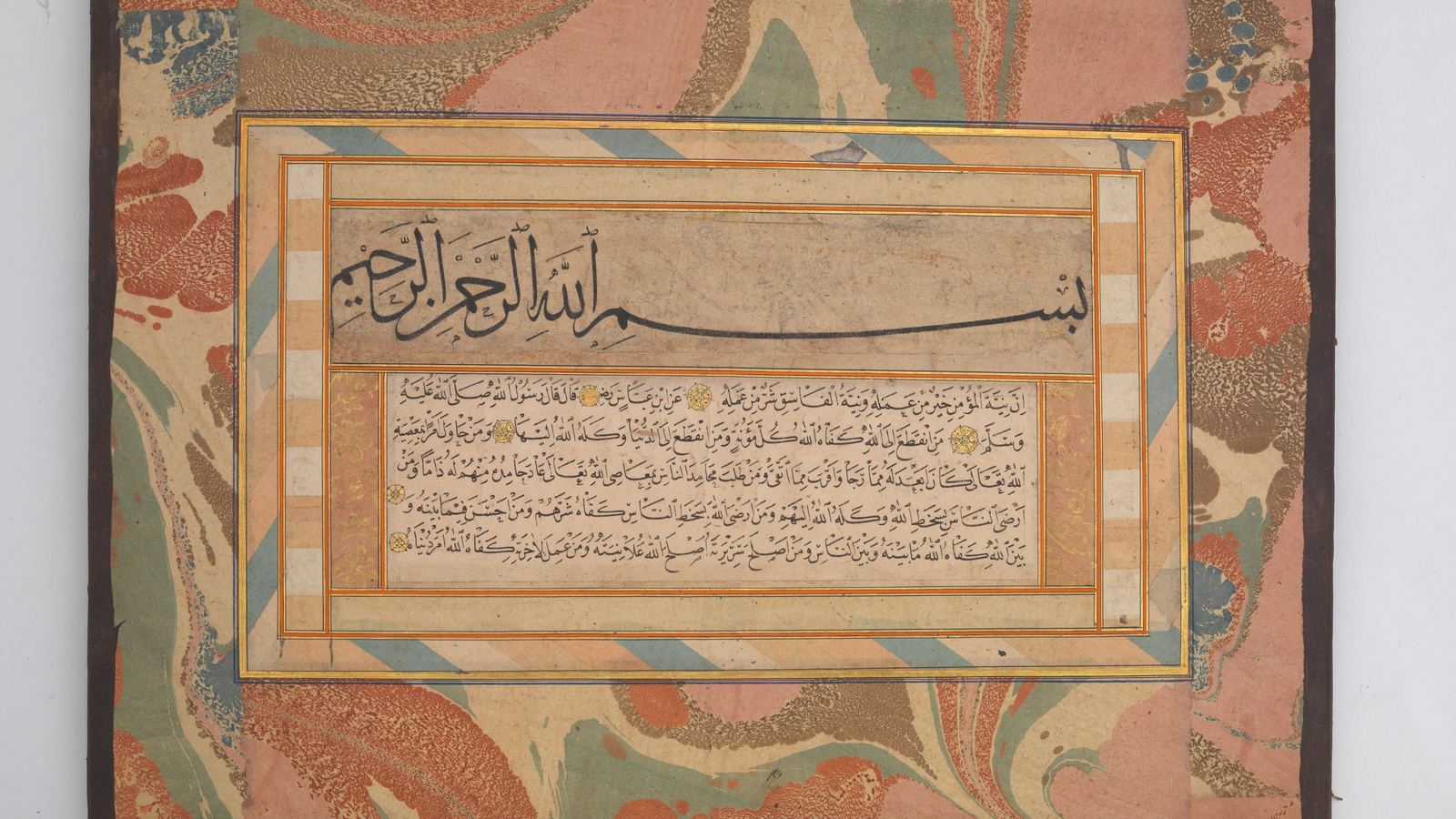
- Hero image: "Album of Calligraphies Including Poetry and Prophetic Traditions (Hadith)", Shaikh Hamdullah ibn Mustafa Dede, The Metropolitan Museum of Art, via Wikimedia Commons, CC0 1.0 public domain dedication. Cropped and resized.