
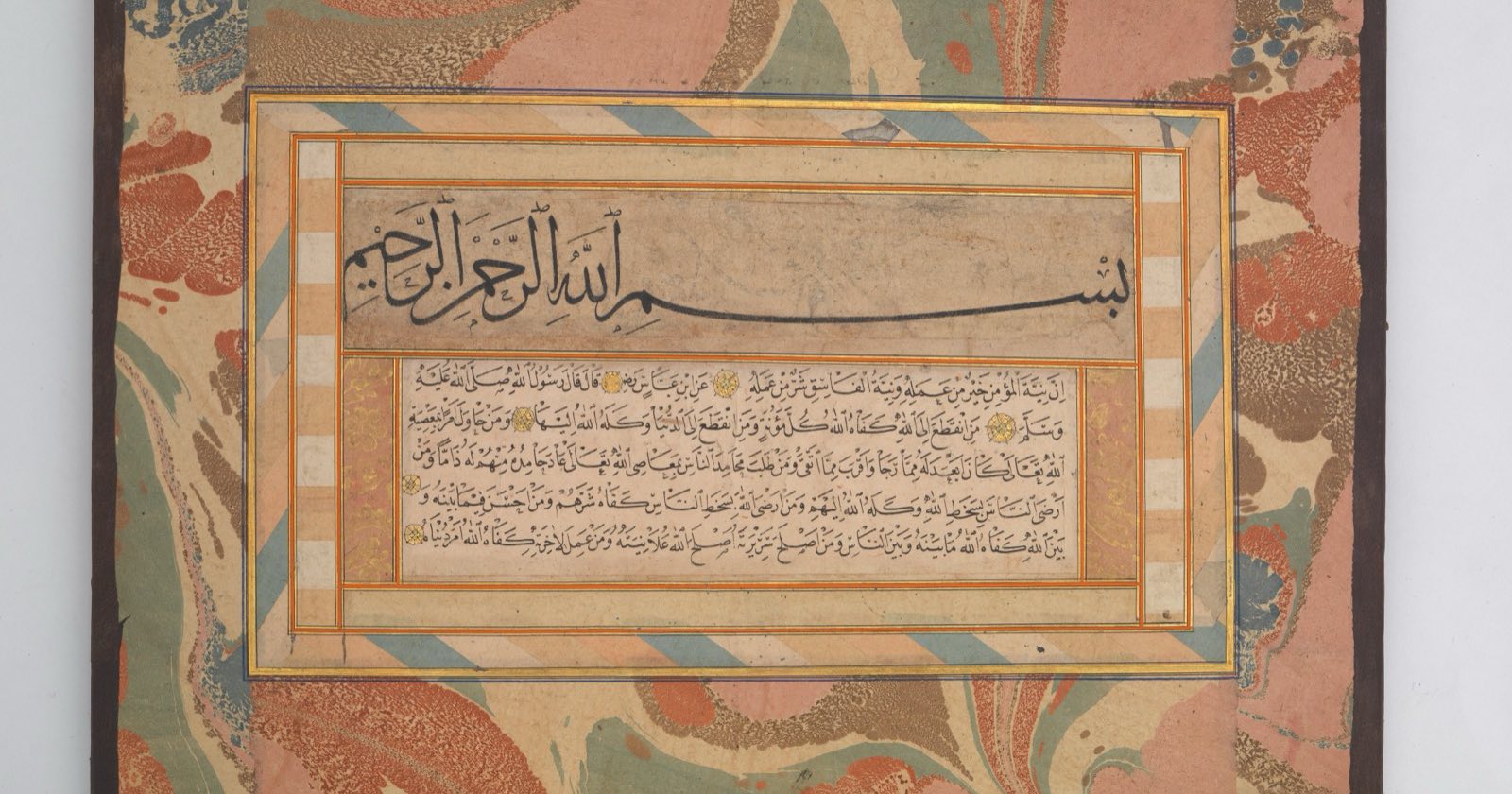
People often use "hadith" and "Sunnah" as if they were two names for one thing. In everyday speech that is mostly harmless, and many scholars use the words interchangeably too. But the two terms were not born with the same meaning, and when you start reading the collections seriously, the difference helps you understand what you are looking at.
I come to this as a software engineer, not a scholar. In my work the line between a record and the thing a record describes matters a great deal, and that turns out to be a good way into this question. A hadith is a report. The Sunnah is the example that such reports describe.
Key Takeaways
- Short answer: they overlap heavily but are not the same. A hadith is a transmitted report; the Sunnah is the Prophet's ﷺ normative way, which scholars derive from accepted reports.
- Origin of the words: hadith literally means speech or report, while sunnah meant a way or customary practice, even before Islam.
- Three kinds of Sunnah appear in the reports: what the Prophet ﷺ said, what he did, and what he saw and silently approved.
- Not every hadith carries a Sunnah. A report can be weak, can describe a personal preference, or can quote someone other than the Prophet ﷺ.
- For rulings built on these distinctions, ask a qualified scholar; this article explains vocabulary, not law.
Hadith vs Sunnah at a Glance
Hadith and Sunnah differ mainly in what kind of thing each one is: a hadith is a unit of text with a chain of narrators, and the Sunnah is a way of living that those texts document. The table below sums up the comparison before the detail.
| Point of comparison | Hadith | Sunnah |
|---|---|---|
| Literal meaning | Speech, report, something new | A path, way or customary practice |
| What it is | A transmitted report with a chain (isnad) and a text (matn) | The Prophet's ﷺ example: sayings, actions and tacit approvals |
| Form | Words you can quote, number and cite | A practice or norm you follow |
| Can it be graded? | Yes: sahih, hasan, da'if and so on | Scholars establish it from reports they accept |
| Scope | Can include reports about Companions and later figures | Usually refers to the Prophet ﷺ |
| Technical uses | Hadith scholars study it as a transmitted text | Jurists may also use "sunnah" for a recommended act |
What Does Each Word Mean?
The word hadith literally means speech, and also something new. Mohammad Hashim Kamali, writing in the Encyclopedia of Religion, puts the early distinction plainly: "Ḥadīth denoted speech or word whereas sunnah signified actual conduct, or the way of doing something" (Encyclopedia.com).
Sunnah had a life before Islam. Marilyn Robinson Waldman's entry on the term in the same encyclopedia explains that among pre-Islamic Arabs, sunnah carried the force of tribal custom: the accepted practice of a community. In Islam it came to mean "the exemplary, imitable, normative words, deeds, and silent approval of the Prophet himself" (Encyclopedia.com).
So the first difference is in the words themselves. One names a piece of speech that is passed on. The other names a pattern of behaviour that people follow.
In the library, keep the narrator line, narration text and supplied reference together. The source notes explain how these records are presented.
Is a Hadith a Report and the Sunnah a Practice?
Yes, that is the most useful way to hold the two apart. Waldman describes the hadith as "simply verbal reports, tens of thousands of them, about something Muḥammad said or did," and she stresses that hadith and Sunnah "were not coterminous," because legal norms had to be worked out from the reports (Encyclopedia.com).
As an engineer I think of it like a log and a behaviour. A log entry records that something happened, with a source and a timestamp. The behaviour is the pattern you learn by reading many reliable entries. You would not call a single log line "the system's behaviour", and you would not trust a log line from an unreliable source. Hadith scholars applied a far more demanding version of that discipline to people and chains of transmission.
Kamali adds a sentence that I find clarifying: the remaining technical difference is that "sunnah refers to the law or value that is contained in a ḥadīth; hence, a ḥadīth does not necessarily contain a sunnah" (Encyclopedia.com).
The Three Forms of Sunnah, Shown in Real Narrations
The Sunnah reaches us in three forms: sayings, actions and tacit approvals, and hadith reports carry all three. Wael B. Hallaq's entry in the Encyclopedia of the Modern Middle East and North Africa classifies hadith as qawli (reporting the Prophet's ﷺ sayings) and fi'li (reporting his deeds) (Encyclopedia.com), and Waldman's definition quoted above adds his silent approval as the third element. Here is one example of each from the library, quoted exactly as the records print them.
A saying (qawli)
The best-known saying is the hadith of intention, the first narration in Sahih al-Bukhari:
I heard Allah's Messenger (ﷺ) saying, "The reward of deeds depends upon the intentions and every person will get the reward according to what he has intended. So whoever emigrated for worldly benefits or for a woman to marry, his emigration was for what he emigrated for."
Narrated 'Umar bin Al-Khattab. Sahih al-Bukhari 1 (Sahih al-Bukhari 1 in the library)
Read the same narration in Nawawi's collection with its supplied source note.
An action (fi'li)
Sometimes the instruction is to copy what was seen. In this report a group of young men stayed with the Prophet ﷺ for twenty days and nights, and before they left he told them:
"Pray as you have seen me praying and when it is the time for the prayer one of you should pronounce the Adhan and the oldest of you should lead the prayer.
Narrated Malik. Sahih al-Bukhari 631 (Sahih al-Bukhari 631 in the library)
The words are a hadith. What they point to, the prayer as the Companions watched it performed, is Sunnah by action.
A tacit approval (taqriri)
The third form is something done in the Prophet's ﷺ presence that he saw and did not object to. Ibn 'Abbas describes a meal in the house of Maimuna, where a roasted lizard was served:
I and Khalid b. Walid went to the apartment of Maimuna along with Allah's Messenger (ﷺ), and there was presented to him a roasted lizard. Allah's Messenger (ﷺ) stretched his hand towards It, whereupon some of the women who had been in the house of Maimuna said: Inform Allah's Messenger (ﷺ) what he intends to eat. Allah's Messenger (ﷺ) lifted his hand. I said: Messenger of Allah, Is it forbidden? He said: No. It is not found in the land of my people, and I feel that I have no liking for it. Khalid said: I then chewed and ate it, while, Allah's Messenger (ﷺ) was looking (at me).
Abdullah b. 'Abbas reported. Sahih Muslim 1945 a (Sahih Muslim 1945 a in the library)
The Prophet ﷺ answers that the lizard is not forbidden and that he simply has no liking for it, a personal preference he explains himself. Khalid ibn al-Walid then eats it while the Prophet ﷺ watches, and that silence is the approval. Reading the whole report, rather than one line of it, is what lets you tell those apart.
Which Hadith Do Not Establish a Sunnah?
Not every hadith establishes a Sunnah. Treating every report as a practice to follow skips the sorting work scholars did, and three cases show why.
- Weak reports. A hadith record can exist and still be graded weak. Jami at-Tirmidhi 2630 even mentions "my Sunnah" in its text, yet the record in our library carries the grade Da'if (Darussalam) (Jami at-Tirmidhi 2630 in the library). The word appearing in a report does not make the report reliable. Preserve the grade's attribution when quoting the record.
- Personal habits and preferences. As the Maimuna narration shows, the Prophet ﷺ sometimes said plainly that a choice was his own taste, not a rule.
- Reports that stop at someone else. Harald Motzki notes that "as a scholarly term hadith means tradition," and the material includes reports about the first generations of Muslims as well as the Prophet ﷺ (Encyclopedia.com). Check the attribution in the particular report before describing its speaker.
Deciding which reports establish a practice, and at what level, is the work of qualified scholars. I am describing categories so you can read more carefully, not offering rulings.
Where Does the Word "Sunnah" Appear in Hadith?
The word itself appears inside hadith, which is one reason people merge the two. In a well-known narration, three men decided to pray all night, fast every day and never marry. The Prophet ﷺ answered:
"Are you the same people who said so-and-so? By Allah, I am more submissive to Allah and more afraid of Him than you; yet I fast and break my fast, I do sleep and I also marry women. So he who does not follow my tradition in religion, is not from me (not one of my followers).
Narrated Anas bin Malik. Sahih al-Bukhari 5063 (Sahih al-Bukhari 5063 in the library)
The Arabic behind "my tradition" is sunnati:
فَمَنْ رَغِبَ عَنْ سُنَّتِي فَلَيْسَ مِنِّي
In a narration from Irbad ibn Sariyah, the Prophet ﷺ advised:
You must then follow my sunnah and that of the rightly-guided caliphs. Hold to it and stick fast to it.
Narrated Irbad ibn Sariyah. Sunan Abi Dawud 4607, graded Sahih (Al-Albani) (Sunan Abi Dawud 4607 in the library)
In both cases a hadith (a report) tells you to hold to a Sunnah (a way).
Why Do Scholars Sometimes Use the Words Differently?
Different disciplines use "sunnah" for different jobs, so its meaning shifts with the field. Waldman notes that sunnah also has a narrower technical sense in Islamic law "for a certain level of permissibility of acts," and warns readers not to confuse that with the broader meaning (Encyclopedia.com). In a book of law, "this act is sunnah" usually means it is recommended. In a book of hadith, "the Sunnah" usually means the Prophet's ﷺ whole example.
Waldman also credits the jurist al-Shafi'i with establishing the Prophet's ﷺ example as a source of law second to the Qur'an (Encyclopedia.com). Kamali, for his part, notes that over time the two words "became largely synonymous" in general use (Encyclopedia.com). So if you hear a teacher use them interchangeably, they are not wrong; they are using the common sense of the words.
How to Keep the Difference in Mind While Reading
The practical habit is simple: treat each hadith as evidence to be cited, and treat the Sunnah as what qualified scholars conclude from the evidence.
- Keep the reference with every narration you save. Notice that the number in a library URL is a record id, while the citation is the printed reference (Sahih al-Bukhari 631 sits at record 618). The library's numbering notes explain this distinction.
- Look at the grade and who graded it before relying on a report.
- Read the full narration, not one line, so you can see whether the Prophet ﷺ was instructing, acting, approving or describing his own preference.
- Use the library search to find other narrations on the same topic, and read the notes on where the library's texts come from.
Frequently Asked Questions
Is it wrong to use "hadith" and "Sunnah" interchangeably?
No. In general use the terms have become largely synonymous, as Kamali notes. The distinction matters when you need precision: a hadith is the report, and the Sunnah is the example or norm drawn from accepted reports.
Where is the Sunnah written down?
In the hadith collections. Waldman explains that the norms of the Sunnah had to be derived from the hadith reports, so the collections are the main written record scholars study it from. The Sunnah itself is the conclusion qualified scholars draw from that record, not a separate book.
Can a hadith be authentic and still not be a Sunnah to follow?
Yes. An authentic report can describe a personal preference, as in Sahih Muslim 1945 a, or something specific to a situation. Working out what a reliable report requires of Muslims is a task for qualified scholars.
Verdict: Related, but Not Identical
Hadith and Sunnah are closely related but not identical: one is the record, the other is the example it preserves. Reading with that in mind leads to better questions about every narration: who reported it, how it is graded, and whether it records a saying, an action, an approval or a personal preference. For the next step, compare the six major hadith collections and open their source records.
Sources
- Kamali, Mohammad Hashim. "Ḥadīth." Encyclopedia of Religion, 2nd ed., 2005. Via Encyclopedia.com, retrieved 2026-11-05.
- Waldman, Marilyn Robinson. "Sunnah." Encyclopedia of Religion, 1987. Via Encyclopedia.com, retrieved 2026-11-05.
- Motzki, Harald, "Hadith," Encyclopedia of Islam and the Muslim World; Hallaq, Wael B., "Hadith," Encyclopedia of the Modern Middle East and North Africa. Via Encyclopedia.com, retrieved 2026-11-05.
- Sahih al-Bukhari 1, 631 and 5063; Sahih Muslim 1945 a; Sunan Abi Dawud 4607; Jami at-Tirmidhi 2630. Quoted from the Hadith Collection library.
- Hero image: Album of Calligraphies Including Poetry and Prophetic Traditions (Hadith), attributed to Shaikh Hamdullah ibn Mustafa Dede, The Metropolitan Museum of Art, CC0, via Wikimedia Commons.
